What Sleep Does to What You Studied
The same six hours of study produce different results depending on when you sleep after them.
01Why it works
Memory consolidation continues during sleep, and the two main stages seem to favour different material. Slow-wave sleep early in the night is associated with declarative recall — facts and word pairs — while REM later in the night is associated with procedural and integrative work. The practical consequence is that cutting sleep short removes REM disproportionately, because REM clusters in the final hours. Studying until 2 a.m. and waking at 6 removes most of it.
02The five moves
-
1
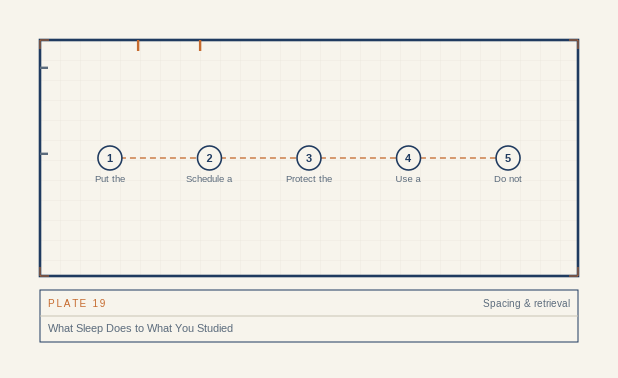
Put the hardest new material in the hours before your longest sleep, not before your longest study session.
Looks likeIf you sleep at 23:00, a 20:30 session on new vocabulary beats a 06:00 session, even though the morning session is quieter.
-
2
Schedule a short review immediately before sleep rather than a long one.
Looks likeTen minutes of retrieval on cards you already know, not a two-hour push through new material, which will fragment your sleep onset.
-
3
Protect the last ninety minutes of sleep. It is a distinct stage, not spare time.
Looks likeAn alarm at 05:30 after a 01:00 bedtime costs you the entire REM-dense tail, which is the part your integration work depends on.
-
4
Use a nap for the gap between two study blocks rather than for recovery from a short night.
Looks likeTwenty minutes after a morning block consolidates it; ninety minutes is enough to include one full cycle, but napping to compensate for four hours of lost night sleep does not work.
-
5
Do not trade sleep for study time in the week before a test. The exchange rate is negative.
Looks likeAn extra two hours of cramming against two hours of lost sleep leaves you with more material seen once and less of the material you had already learned.
03Worked example
| Image in the head | Anchor point |
|---|---|
| 19:00–21:00 study, then asleep at 23:00, up at 07:00. | Full slow-wave and full REM window. Retention at day 3: highest of the four. |
| 19:00–21:00 study, then asleep at 01:00, up at 07:00. | Slow-wave window mostly intact, REM tail truncated. Day-3 retention drops measurably. |
| 06:00–08:00 study, then a normal night. | Good consolidation, but eleven hours of waking interference before it. Slightly lower than the evening group. |
| 22:00–00:30 study, then up at 05:30. | "Most material seen, least retained. This is the pattern that produces the \"I studied and forgot everything\" report." |
04Where it breaks
- Treating sleep as time that could have been study time. It is the only consolidation window you get, and it cannot be moved to the weekend.
- Relying on all-nighters for anything cumulative. Skills and vocabularies learned across weeks are exactly what an all-nighter damages.
- Using alcohol to fall asleep before an exam. It reduces REM in the first half of the night, which is the half you were relying on.
- Assuming a nap is equivalent to a full night. A nap can rescue a bad night's alertness, not its consolidation.
05Practice drill
00:00
10 min
For one week, log two numbers each day: the time you started studying and the time you went to bed. Each morning, spend five minutes retrieving yesterday's material cold and score it out of ten. By day seven you will have your own data on the gap between study and sleep, which is more convincing than any general claim about sleep and memory.
Run the drill with the clock on. Stop when the instructions say to.
06Questions
Does this mean I should study right before bed?
Light review, yes; intensive new material, no. The strongest version is study earlier in the evening and a short retrieval pass in the last fifteen minutes before sleep.
What about people who genuinely need less sleep?
Short sleepers exist but are far rarer than the number of people who believe they are short sleepers. The test is whether performance holds up across weeks without stimulants, not whether you can function for two days.
Is there a substitute for the consolidation window?
Nothing equivalent. Exercise and spacing both improve retention, but they act on encoding and retrieval rather than on the offline consolidation that sleep provides. They add to sleep; they do not replace it.