Testing Yourself Is the Study, Not the Check
The test effect is larger than the rereading effect, and almost nobody uses it.
01Why it works
Pulling information out of memory changes the memory more than putting it in again. In the classic comparison, a group that reads a passage four times is beaten on a delayed test by a group that reads it once and tests itself three times — and the winning group predicts it will do worse. The mechanism is that successful retrieval strengthens the route back to the information, while rereading only strengthens the feeling that the information is familiar.
02The five moves
-
1
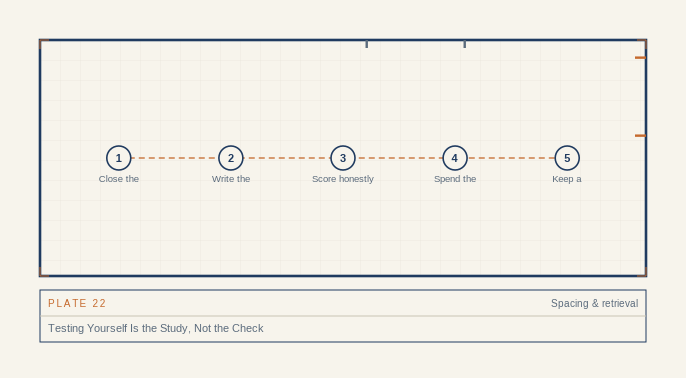
Close the book before you feel ready. Readiness is not the signal to test; the end of a section is.
Looks likeRead one section, close it, write everything you can recall on a blank page. The blank page is uncomfortable, which is why it works.
-
2
Write the questions before you know the answers, and keep them.
Looks likeTurning each heading into a question takes five minutes and gives you a reusable test that a summary can never be.
-
3
Score honestly, and count "I knew it once I saw it" as a miss.
Looks likeRecognition feels identical to recall from the inside, and only one of them survives an exam. The score you write down must reflect production.
-
4
Spend the review time on what you missed, not on what you got right.
Looks likeHighlighting the whole page after a bad test is the classic error; it turns a test into a reread and throws away the diagnostic it just produced.
-
5
Keep a running error list and test it first next time.
Looks likeTen lines in a notebook, re-tested at the start of every session, will beat any amount of careful re-reading of the chapter.
03Worked example
| Image in the head | Anchor point |
|---|---|
| Routine A — read the chapter four times across a week. | Predicted score: high. Actual: lowest of the three. Fluency was read as knowledge. |
| Routine B — read once, then make a concept map. | Predicted: medium. Actual: middle. Building the map adds structure but little retrieval. |
| Routine C — read once, then three closed-book recall attempts with an error list. | Predicted: lowest. Actual: highest, and by a wide margin on the items that had been missed. |
04Where it breaks
- Testing with the answers visible. A test you can look through is a reread with extra steps.
- Testing only what you already know. Comfortable retrieval produces almost no gain; the productive zone is where you are failing some of the time.
- Treating a low score as evidence that testing does not work. A low score is the diagnostic working, not the method failing.
- Rereading immediately after a failed recall. Give the miss a day before looking it up; the extra failure makes the eventual retrieval stronger.
05Practice drill
00:00
10 min
Take any text you have already read. Write eight questions from its headings without looking at the body. Close the text and answer all eight, scoring each as "produced", "recognised" or "blank". Then study only the ones marked recognised or blank. Repeat the same eight questions tomorrow and count how many moved from blank to produced — that number is your actual rate of learning, and it is the only one worth tracking.
Run the drill with the clock on. Stop when the instructions say to.
06Questions
Do flashcards count as retrieval practice?
Yes, if you answer before flipping. The moment you flip first and read, the card has become a reread and the effect drops sharply.
How often should I be failing?
Roughly a quarter of items on any given test. Near-perfect scores mean the material is already stored and the session is maintenance; near-zero scores mean the questions are too large to retrieve at all.
Why do I do worse on tests than I expected, even after studying?
Because rereading raises your confidence without raising your retrievability. The gap between those two is the most reliable finding in the field and the reason self-testing feels so much worse than it performs.