Dual Coding: Words Plus Your Own Drawing
A diagram you copied is worth less than a bad sketch you drew yourself.
01Why it works
Verbal and visual information are handled by partly separate systems, so a fact encoded both ways has two routes back instead of one. The effect depends on who draws the picture. Studies that compare learner-generated drawings with supplied diagrams consistently find the advantage on the side of the drawing the learner produced, even when it is objectively worse. Generating the image forces you to decide what matters and where it sits, and that decision is the encoding.
02The five moves
-
1
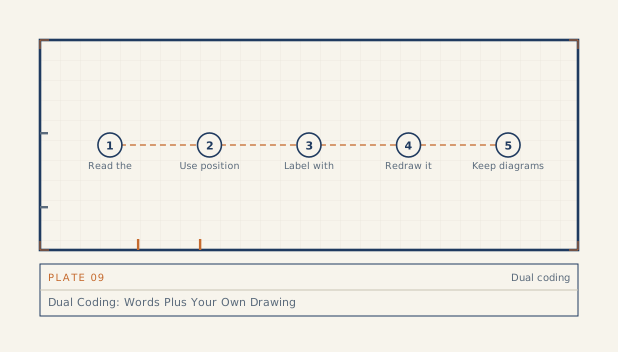
Read the material once, then close it. Draw from memory only.
Looks likeRead the four stages of a process, close the page, then draw four boxes and the arrows between them without looking.
-
2
Use position to carry meaning. Left-to-right for time, top-to-bottom for hierarchy, centre-out for influence.
Looks likeA feedback loop must curve back; if you draw it as a straight line the diagram is lying about the mechanism.
-
3
Label with your own words, then reopen the source and correct only the errors.
Looks likeIf you wrote "cell wall" where the source says "cell membrane", fix the label rather than redrawing the whole thing.
-
4
Redraw it a second time, from the corrected version, two days later.
Looks likeThe second drawing takes a third of the time and is the step that converts the diagram into recall.
-
5
Keep diagrams small. One idea per page; a diagram that needs a legend has become a document.
Looks likeSix boxes maximum for a first attempt. Beyond that you are copying, not encoding.
03Worked example
| Image in the head | Anchor point |
|---|---|
| Verbatim notes — a page of copied sentences. | Recall after a week: weak. Nothing forces a decision. |
| A supplied diagram, highlighted in three colours. | Recall after a week: moderate. Familiarity is mistaken for knowledge. |
| Your own four-box sketch with curved arrows and one wrong label corrected in red. | Recall after a week: strongest. The wrong label is remembered precisely because you fixed it. |
04Where it breaks
- Drawing beautifully. Neatness spends the time that should go on deciding what the boxes are.
- Copying the textbook figure. A traced figure encodes the textbook's decisions, not yours.
- Adding art instead of structure. A decorative border does not create a second encoding path; position and arrows do.
- Drawing once. One pass produces a nice artefact and almost no recall; the value is in the second, faster redraw.
05Practice drill
00:00
12 min
Pick something you have to learn this week that has parts and relationships — a process at work, a biological pathway, a legal procedure. Close the source and draw it in six boxes or fewer. Reopen the source, correct with a red pen, and note how many corrections you made. Two days later, redraw from the corrected version and count again; the drop between the two correction counts is your progress.
Run the drill with the clock on. Stop when the instructions say to.
06Questions
Does this only work for visual subjects?
No. It works best where relationships matter — sequences, hierarchies, causes. For a pure list of unrelated facts, a palace or a peg board will beat a diagram.
Can I use software instead of pen and paper?
You can, but the speed of a pen matters here. Software encourages rearranging an existing shape; a pen forces you to commit to a position and then live with it, which is where the encoding happens.
My drawing is genuinely bad. Does that hurt?
Not for recall. The only thing a bad drawing costs is that someone else cannot read it, which is irrelevant if the diagram is a study tool for you. Keep it private and keep drawing.