Building a Spacing Schedule You Will Actually Keep
The hard part of spaced repetition is not the interval maths, it is day four.
01Why it works
Each time you retrieve something at the edge of forgetting, the forgetting curve flattens, so the next interval can be longer. That much is well established. What most schedules get wrong is the review load: a system whose day-30 pile takes two hours gets abandoned around day 12. The version that survives is built backwards from how many minutes you will actually give it, not forwards from an ideal interval sequence.
02The five moves
-
1
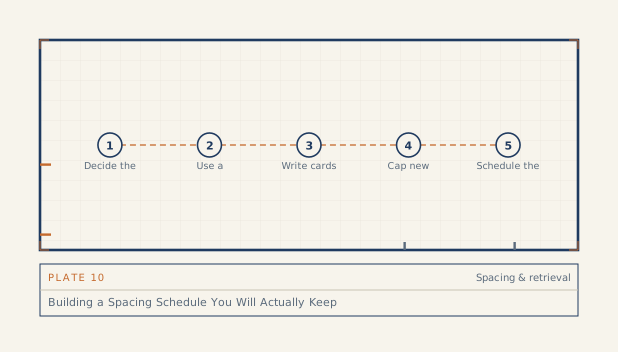
Decide the daily ceiling first — minutes per day, not intervals.
Looks likeFifteen minutes a day is a realistic ceiling for most people with a job. That is roughly 40 to 60 retrieval cards, which caps how much new material you can add per week.
-
2
Use a fixed ladder rather than adaptive software for your first month: day 1, 3, 7, 16, 35.
Looks likeA card written on the 1st is reviewed on the 1st, 3rd, 7th, 16th and 35th. Five touches, then it retires.
-
3
Write cards as questions with one answer each, and put the cue in the question, not the answer.
Looks likeNot "the Krebs cycle" but "which stage of the Krebs cycle produces GTP?" — the second one is retrievable, the first one is a topic.
-
4
Cap new cards per day so the day-35 pile cannot balloon.
Looks likeTen new cards a day means about fifty reviews a day once the ladder is full. Twenty new cards a day means a hundred, which is where people quit.
-
5
Schedule the review slot against an existing habit, and make the miss rule explicit.
Looks like"After the first coffee, at the kitchen table" beats "in the morning". If you miss a day, run that day's pile and skip the next day's new cards — never double up.
03Worked example
| Image in the head | Anchor point |
|---|---|
| Day 1 — written and answered immediately while the source is open. | Effort: low. This pass does almost nothing on its own. |
| Day 3 — recalled cold, slowly, with one wrong detail corrected. | Effort: high. This is the pass that does most of the work. |
| Day 7 — recalled in about two seconds. | Effort: low. Correctly low — the item is being stored, not learned. |
| Day 16 — nearly missed, then recovered. | Effort: medium. Near-misses at long intervals are the point of the ladder. |
| Day 35 — instant, and the card is retired. | Effort: minimal. Five touches total, roughly four minutes of real work. |
04Where it breaks
- Adding cards faster than you retire them. The backlog is a debt with a daily interest rate, and it is what kills the system.
- Marking a card correct when you only recognised it. Recognition after seeing the answer is not retrieval; if you did not produce it before looking, it counts as a miss.
- Reviewing in the same order every time. Order becomes a cue, and you end up remembering the sequence rather than the content.
- Rewriting the cards instead of answering them. Reformatting feels productive and produces no retrieval practice at all.
05Practice drill
00:00
15 min
Take ten facts you need this month and write them as question cards. Set the ladder at day 1, 3, 7, 16 and 35 on a paper calendar. Answer them cold today and time yourself. Then answer them again on day 3 and record the time difference — the gap between the two timings is the first honest evidence you will get that the schedule is working.
Run the drill with the clock on. Stop when the instructions say to.
06Questions
Do I need software?
No. A paper calendar plus an index-card box implements the same ladder, and the manual act of sorting cards is itself a retrieval cue. Software earns its place when you pass roughly 150 active cards, where manual sorting starts to cost real time.
What if I keep failing the same card?
The card is the problem, not your memory. Split it into two smaller questions or add a concrete cue. A card failed four times in a row is a badly written card.
Can I space material the same day instead of across days?
Same-day spacing does help a little, but the gain is small compared with day-to-day spacing, because consolidation during sleep is doing much of the work. If you only have one day, use it for understanding and start the ladder the next day.