Interleaving Feels Worse and Tests Better
The practice method that reliably lowers your confidence while raising your score.
01Why it works
Blocked practice — twenty problems of the same type in a row — produces fast, smooth performance inside the session and poor transfer afterwards. Interleaved practice mixes the types, which forces you to first decide which procedure applies and only then apply it. That decision step is what real problems require, and blocked practice never trains it. The reason people abandon interleaving is that it feels worse: errors are more frequent and the session has no rhythm.
02The five moves
-
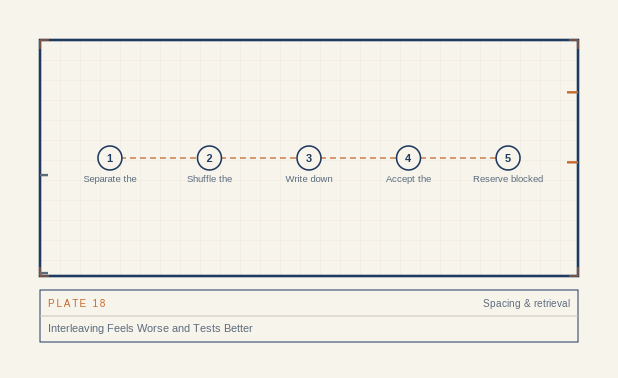
1
Separate the material by problem type first, so you know what you are mixing.
Looks likeA maths chapter with three procedures needs three labelled groups before mixing is even possible.
-
2
Shuffle the types within one session, but keep the number of problems the same as a blocked session.
Looks likeTwelve problems as four of each type, randomised — not thirty-six problems, which is where people burn out.
-
3
Write down which procedure you chose before solving, so the decision is visible.
Looks likeOne line per problem — "looks like a rate problem, use the ratio setup" — takes ten seconds and is the actual skill being trained.
-
4
Accept the error rate inside the session and judge by a delayed test instead.
Looks likeIf blocked practice gets 18 out of 20 today and interleaved gets 13, test both again in a week. The gap usually reverses.
-
5
Reserve blocked practice for the first twenty minutes of something brand new, then switch.
Looks likeYou need a working example of a procedure before you can choose between procedures; blocking is the right tool for that first exposure and the wrong tool after it.
03Worked example
| Image in the head | Anchor point |
|---|---|
| Day 1, blocked — 20 problems of type A, all correct by problem 6. | Feeling: strong. Information gained: low, because problems 7–20 needed no decision. |
| Day 1, interleaved — 20 mixed problems, 13 correct, three abandoned. | Feeling: poor. Information gained: high, because every problem required a choice. |
| Day 8 test, blocked group — 12 out of 20. | The schedule's advantage evaporated exactly where it mattered. |
| Day 8 test, interleaved group — 17 out of 20. | A five-point gap, produced by the schedule and not by extra time on task. |
04Where it breaks
- Interleaving before any procedure is understood. Mixing three things you cannot do produces three kinds of confusion, not discrimination.
- Interleaving unrelated subjects as a substitute for sleep. Switching from chemistry to history is not interleaving; it is just a break.
- Judging the method by how the session felt. Every piece of evidence says the feeling is inverted here.
- Interleaving everything. Motor skills and music practice have their own optimum, which is usually more repetition than verbal material needs.
05Practice drill
00:00
14 min
Take two topics you are currently studying that use different procedures. Make twenty problems — ten of each — and split them into a blocked set and an interleaved set of equal size. Do the blocked set today; before each problem write down which procedure you used. Do the interleaved set tomorrow, same rule. Test both sets again in seven days and count only the delayed score.
Run the drill with the clock on. Stop when the instructions say to.
06Questions
Does interleaving work for reading?
It applies to what you do after reading, not to reading itself. Interleaving two textbooks page by page is not useful; interleaving the questions drawn from both is.
How long should a block be before mixing?
Long enough to complete one problem without help. Typically that is three to five worked examples, or about twenty minutes. After that, more blocking buys fluency on a task you will rarely meet in that form.
My exam is in three days. Is now the time to start interleaving?
No. Interleaving pays off over weeks. With three days left, use blocked practice for the types you can already do and spend the remaining time on recall of the whole syllabus rather than on introducing difficulty.