Delivering a Twenty-Minute Talk Without Notes
The palace holds the structure; the words have to be said out loud before you trust them.
01Why it works
Memorising a talk by its sentences produces a fragile script: one missed phrase derails the rest. Memorising it by its points produces something more robust, because each point is recoverable from its own image. The catch is that fluency needs both — you must know what comes next without hesitation and still be able to say it in words. That means the palace is built from the outline and then rehearsed aloud, which is where most people skip a step.
02The five moves
-
1
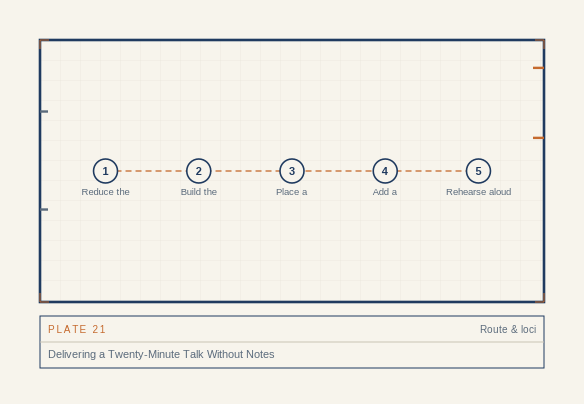
Reduce the talk to five to seven points and no more. If the outline has twelve points you have a document, not a talk.
Looks likeEach point gets one sentence of what it must accomplish, written as a purpose rather than a topic: "show that the cost is paid twice", not "costs".
-
2
Build the palace along the room you will speak from, or along the walk to it.
Looks likeFive points on five stops of a route you walk on the way in: the lift, the corridor, the door, the lectern, the window. The venue's own geography cues the next point before you need it.
-
3
Place a single image per point that encodes the point's purpose, not its wording.
Looks likeFor 'show the cost is paid twice', the image is a till charging the same customer twice in a row. It will regenerate several sentences.
-
4
Add a second, contrasting image for any point you might skip under pressure.
Looks likeThe point you keep dropping gets an image that is physically uncomfortable to hold — a live fish — so its absence is noticeable while you are speaking.
-
5
Rehearse aloud at least three times, once at full volume standing up.
Looks likeSilent rehearsal trains the images and not the delivery. The first time you hear your own sentences out loud should not be in front of the audience.
03Worked example
| Image in the head | Anchor point |
|---|---|
| Point 1 — the problem. Image: a lift that will only go down. | Stop 1 — the lift lobby |
| Point 2 — why the obvious fix fails. Image: a corridor where every door is slightly too narrow for the trolley. | Stop 2 — the corridor |
| Point 3 — the actual mechanism. Image: the door itself has a hinge on the wrong side and a live fish jammed in it. | Stop 3 — the meeting room door (the point most often dropped) |
| Point 4 — what it costs. Image: a lectern with a meter on it, running. | Stop 4 — the lectern |
| Point 5 — the ask. Image: the window is open and the room is emptying out of it. | Stop 5 — the window behind you |
04Where it breaks
- Memorising the script word for word. A memorised script has no recovery path, and one interruption costs you the paragraph.
- Building the palace on a familiar route unrelated to the venue. It works, but the room itself is a free cue you are choosing not to use.
- Rehearsing silently only. Your mouth has not said these sentences yet, and the first delivery will be slower and flatter than the version in your head.
- Adding a sixth and seventh point the night before. New images placed late have not been rehearsed, which is precisely the part that will blank.
05Practice drill
00:00
15 min
Take any five-part structure you know well — an argument, a recipe, a project update. Map it onto five stops on the route from your front door to the street. Say the whole thing out loud twice, standing, without notes, and time it. Then do it once more and deliberately skip point three to see whether you notice the omission while speaking.
Run the drill with the clock on. Stop when the instructions say to.
06Questions
What if the audience asks a question mid-point?
Answer it, then return by naming the image you were on. The palace is what lets you come back to exactly the right place, which is the main advantage it has over a script.
How many stops can a talk have?
Structure at the level of points, typically five to seven. If you need twenty stops you are memorising sub-clauses, and the audience will hear a recitation rather than a talk.
Does this work for a talk in a second language?
It works better, because it removes the load of remembering structure and leaves capacity for the language. The rehearsal requirement doubles, though — rehearse aloud enough that you are not constructing sentences live.