Planning a Route That Will Still Be There in a Month
Most palaces fail because the building changed, not because the images were bad.
01Why it works
A palace is only as stable as the route underneath it. Images fade and can be rebuilt in minutes; a route that has been renovated, rearranged or demolished takes the whole list with it. Planning a palace therefore looks less like mnemonics and more like choosing a location for a filing cabinet: what has not moved in five years, what has enough distinct surfaces, and what can be walked in one continuous line without doubling back.
02The five moves
-
1
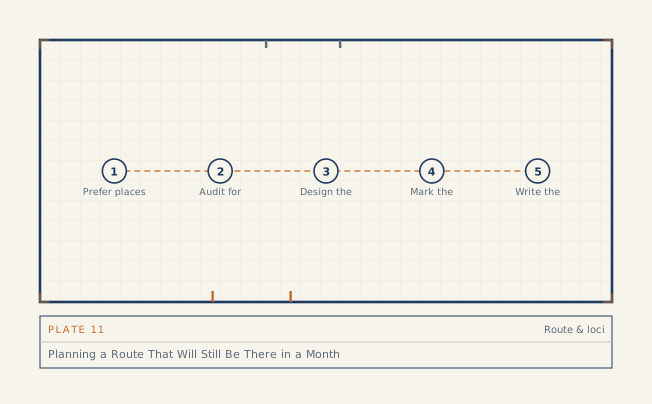
Prefer places that are architecturally frozen: a childhood home, a school you attended for years, a museum you know well.
Looks likeA childhood home is the strongest default because you have walked it thousands of times and no landlord can repaint your memory of it.
-
2
Audit for distinctiveness before committing. Every stop must be unmistakable at a glance.
Looks likeSix identical office desks in a row is a bad route. Six stops must differ in shape, height, colour or object, or you will lose items at the merge points.
-
3
Design the walk as one continuous line with no backtracking and no ambiguous branch points.
Looks like"Enter, turn right, straight to the end, turn left" is usable. "Go into whichever room you like" is not, because the order stops being supplied by the building.
-
4
Mark the start and the end deliberately, and make the end distinct from the start.
Looks likeIf the route is a loop that returns to the front door, the tenth image and the first image share a location and will cross-contaminate.
-
5
Write the route down once as a numbered list and keep it. Rebuilding a route from memory after a gap is much slower than reading it back.
Looks likeA ten-line text file per palace is enough. Store them together; by your fifth palace you will have forgotten which route holds which list.
03Worked example
| Image in the head | Anchor point |
|---|---|
| Current flat — high familiarity, low stability. | Verdict: fine for short-lived lists. Furniture moves, and you will redecorate. |
| Secondary school corridor, 1998–2003 — high familiarity, high stability. | Verdict: the best option for anything you need for years. Nothing there has moved. |
| A hotel you stayed in twice — low familiarity, high stability. | Verdict: rejected. Stability does not compensate for a route you cannot walk without hesitating. |
04Where it breaks
- Building a palace in a place you currently work or live. Seasonal rearrangements will quietly delete stops.
- Using an outdoor route in a city that rebuilds itself. Roadworks move street furniture; a removed bench removes the item that was on it.
- Adding an eleventh stop by squeezing it into a hallway. The new stop lengthens the walk without giving the image its own surface, and everything near it starts to blur.
- Choosing a route with no lighting, no floor changes, and identical doors. Doors are the most common place to drop an item.
05Practice drill
00:00
14 min
List three places you could use as a palace. For each, write ten stops and score them out of five for distinctiveness. Then walk the best route twice out loud, from memory, naming each stop — no images yet. If you cannot name all ten stops in order twice, the route is not ready, and no amount of image work will fix it.
Run the drill with the clock on. Stop when the instructions say to.
06Questions
How many palaces do I need?
One per active list. Most people stabilise at three to six. Beyond that you need a written index, because the failure mode shifts from forgetting items to forgetting which route holds what.
Can I reuse a palace for a new list?
Yes, overwriting is the normal lifecycle. Expect the old list to be gone; if you still need it, move it to a second palace rather than trying to hold both on one route.
Should the route be bigger or smaller for a beginner?
Smaller. A well-used eight-stop palace beats a shaky twenty-stop one. Add stops only when the existing ones are automatic, which usually takes about a month of practice.