The Method of Loci, Start to Finish
Ten stops, one route you could walk blindfolded, and a dinner list that survives a week.
01Why it works
Spatial memory is the one memory system people run without training — most adults can still describe the layout of a childhood kitchen decades later. The method of loci borrows it. Each item is converted into an image and pinned to a physical location along a fixed route, so recall stops being a search and becomes a walk. Three things carry the load: the route is over-learned, the images are exaggerated enough to stay distinct, and the order is supplied by the building instead of by effort.
02The five moves
-
1
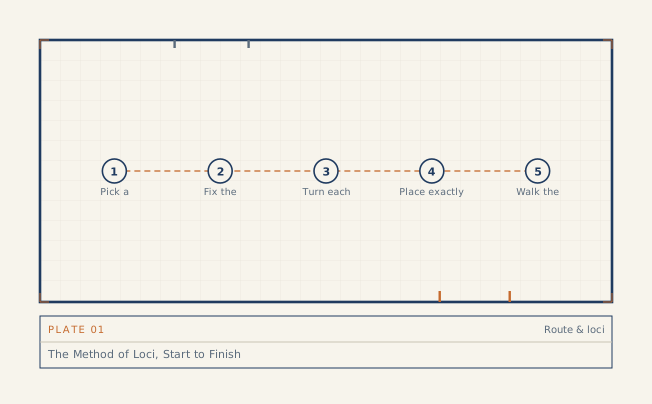
Pick a route you could walk with your eyes shut — your flat, one floor of your office, the walk from the bus stop.
Looks likeThe flat: front door, shoe rack, coat hooks, hallway mirror, kitchen door, kettle, fridge, sink, table, balcony door.
-
2
Fix the order and write it down. Ten stops is the practical ceiling for a first palace; a longer list gets a second palace, not a longer route.
Looks likeNumber the ten stops 1–10. If you cannot recite them without hesitating, the route is not ready yet.
-
3
Turn each item into one image that is doing something — moving, spilling, breaking, shouting. Nouns that sit still get forgotten.
Looks likeMilk becomes a carton that has split and is pouring itself across the shoe rack.
-
4
Place exactly one image per stop and make it touch the furniture. The contact is the hook.
Looks likeAt stop 3 the coat hooks are wearing bananas as hats; at stop 6 the fridge door is trying to shut on a bag of spinach.
-
5
Walk the route twice at speed, then once backwards. The backward pass is the test, not the forward one.
Looks likeA forward pass takes about 40 seconds; walking backwards is what exposes stops 6 and 7 as too similar to each other.
03Worked example
| Image in the head | Anchor point |
|---|---|
| A whole raw chicken sitting on the doormat, refusing to come inside. | 1 — front door / doormat |
| Lemons wearing the coats on the hooks, one lemon per hook. | 2 — coat hooks |
| The mirror has gone black and olives are pouring out of the frame. | 3 — hallway mirror |
| A litre of cream has flooded the shoe rack up to the top shelf. | 4 — shoe rack |
| The kettle is screaming and spitting coffee beans across the counter. | 5 — kitchen kettle |
| The fridge door is open and a bag of spinach is trying to escape. | 6 — fridge |
| The sink is boiling over with water and dry pasta. | 7 — sink |
| A wheel of parmesan wedged in the balcony door so it cannot close. | 8 — balcony door |
04Where it breaks
- Reusing the same image twice. Two "something spilling" pictures at stops 4 and 7 will swap places on recall. Give every item a different verb.
- Building a palace from a place you have visited once. Route familiarity fails long before image quality does.
- Packing thirty stops into one route. Accuracy for beginners drops sharply past roughly a dozen stops; use two palaces walked in sequence.
- Hanging images in empty air. Every image needs a surface to touch — a shelf, a door frame, a chair back.
05Practice drill
00:00
10 min
Have someone read you ten unrelated nouns at three-second intervals while you place them on the ten-stop route you wrote down. When the list ends, walk the route once in your head and write down what you saw, then check against the original. Score yourself out of ten. Repeat the next day with ten new nouns on the same route — the route stays, the images change.
Run the drill with the clock on. Stop when the instructions say to.
06Questions
Does the route have to be indoors?
No, but outdoor routes need fixed landmarks — a specific tree, a postbox, a particular shop door. Anything that can move on its own, such as parked cars or people, makes a poor locus.
Can the same palace hold two lists at once?
Not reliably. Overwriting a palace is normal and fine, but recalling the older list afterwards is unreliable. Keep one active palace per list and retire the route when you are done with it.
Why do my images come back as a blur instead of a picture?
Usually because the image is a noun rather than an action. Recall is cued by change, so rebuild it as something that is happening — not "a hammer" but "a hammer is smashing the shelf".