The Story Method, and Where It Beats a Palace
For ten items, a story is faster to build than a palace — and for thirty, it is worse.
01Why it works
A story supplies order for free, because each event implies the next one. That makes it the fastest structure to improvise: no route to write down, no stops to audit, no rehearsal needed before placing items. It also has a hard limit. Narrative memory is serial — you can only enter it at the beginning and walk forward — so a story of forty items costs a long walk to reach item thirty-five, while a palace lets you jump straight to stop 35.
02The five moves
-
1
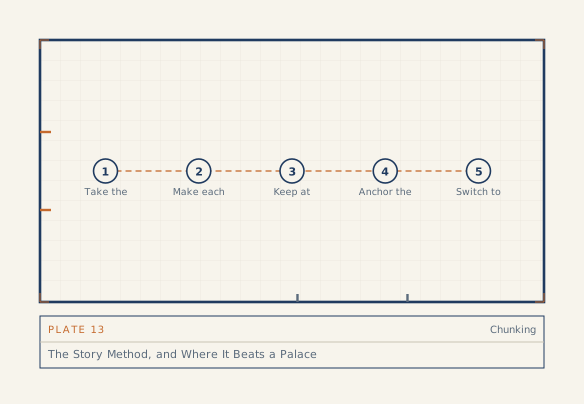
Take the items in the order given and convert the first one into an actor, not a prop.
Looks likeFor a list starting with "vitamin D", do not picture a pill on a table; make the pill walk in and sit down.
-
2
Make each next item do something to the previous actor. Cause and effect, not proximity.
Looks likeThe pill drinks the milk and immediately turns blue and starts dancing, which is why the milk is now blue.
-
3
Keep at most three actors alive at any moment. Retire one as you introduce the next.
Looks likePill, milk, then a dancing shoe that kicks the milk off the stage — now the cast is milk-free and the shoe carries the thread.
-
4
Anchor the story to a location you know, even if you do not use the locations in order.
Looks likeThe whole chain happening inside your kitchen gives you furniture to collide with, which supplies the exaggeration the story needs.
-
5
Switch to loci past roughly twelve items, or when the list is ordered by something you will need to jump within.
Looks likeA recipe with twelve steps is fine as a story. A 40-term glossary is not — you will need to pull out term 27 on demand.
03Worked example
| Image in the head | Anchor point |
|---|---|
| The alarm clock gets up first and goes to brush its own face. | link 1 → 2 (clock acts on brush) |
| The toothbrush is so shocked it spits toothpaste into the kettle. | link 2 → 3 (brush acts on kettle) |
| The kettle boils over and floods the running shoes. | link 3 → 4 (kettle acts on shoes) |
| The shoes run out of the door and knock the keys off the hook. | link 4 → 5 (shoes act on keys) |
| The keys unlock a briefcase, which is full of bread. | link 5 → 6 (keys act on briefcase) |
| The bread is buttered by a passing bus. | link 6 → end |
04Where it breaks
- Building a story with no causal links. "The keys, then the bread, then the bus" is a list wearing a story's clothes and it behaves like a list.
- Letting the cast grow. Five actors on stage at once is where recall starts dropping items.
- Using the story method for a list you must index. Stories are entered from the front; if you need item 22 on demand, use a palace.
- Reusing one story across days. Without a written record you will not notice that yesterday's chain has merged with today's.
05Practice drill
00:00
8 min
Write down eight unrelated items. In ninety seconds, chain them into a story where every item acts on the next. Recite the chain forward, then say item six alone without starting from the beginning — if you cannot, note that this is the limitation the palace exists to fix, then rebuild the same eight items as a route and compare which one you can index.
Run the drill with the clock on. Stop when the instructions say to.
06Questions
Is the story method the same as a memory palace?
They are different structures that are often used together. A palace gives you addresses you can jump to; a story gives you a chain with no addresses. The strongest version of each is a story told inside a palace, which is how competitive memorisers handle long sequences.
How long can a story get before it breaks?
Around twelve linked items for most people before indexing fails, and around thirty before forward recall starts wobbling too. Your own limit will show up as the point where you stop being able to say what happened at the midpoint.
Do the images need to be violent or crude?
They need to be distinctive, not crude. Embarrassment is only one way to achieve distinctiveness and it has a cost — an unpleasant chain is one you will avoid reviewing. Weird, loud, physical and oversized work just as well.