Chunking Phone Numbers Past Working Memory
Why eleven digits vanish and three groups of four do not.
01Why it works
Working memory holds roughly four items, not four digits — the limit is on chunks, and a chunk can be any size you have already learned. An eleven-digit number presented as eleven digits is eleven items and falls apart. Presented as three or four familiar-sized groups it becomes three or four items and fits. The trick is not the grouping itself but whether the group is already a unit in your head: 2026 is a unit, 4815 is four digits pretending to be one.
02The five moves
-
1
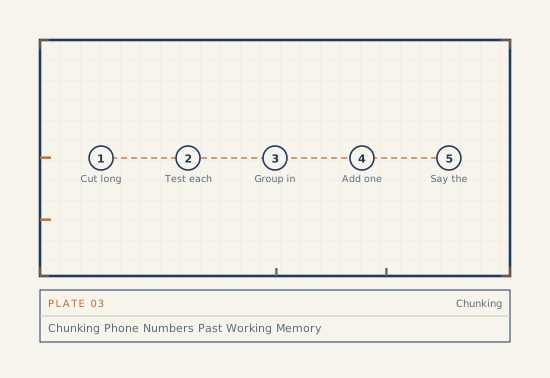
Cut long numbers at the points your language already cuts them — years, prices, house numbers, area codes.
Looks like138 0013 8000 reads as an operator code, a four-digit block and a round thousand, not as eleven digits.
-
2
Test each chunk for meaning. Keep chunks you can attach something to and re-cut the ones you cannot.
Looks like8000 is a round number; 0013 is not, so it borrows the meaning "thirteen past midnight".
-
3
Group in threes and fours, never in fives or sixes. Fives and sixes do not reappear elsewhere in daily life, so they never become free chunks.
Looks like541 0227 9931 fits the rhythm of phone numbers; 54102 27993 1 does not.
-
4
Add one non-numeric anchor per number — where you wrote it, who gave it to you, what the ringtone was.
Looks like"The dentist's number was written on the back of an appointment card" is a cue that survives when the digits alone do not.
-
5
Say the chunked version out loud the way you will say it when someone asks. Rehearsing the delivery is what locks the grouping.
Looks likePractise "oh-four-one-two, seven-six-nine, zero-three-one" rather than reciting the raw string.
03Worked example
| Image in the head | Anchor point |
|---|---|
| 0412 769 031 — an Australian mobile cut as 4-3-3, matching the country's own dialling groups. | chunk rule — official dialling groups |
| 020 7946 0958 — a London landline held as 3-4-4, where 7946 is remembered as "seventy-nine forty-six". | chunk rule — read as two two-digit numbers |
| 138 0013 8000 — a mainland Chinese mobile held as 3-4-4, with 8000 kept because it is round. | chunk rule — round number at the end |
| 555 0134 — a four-and-three split where 0134 is carried as "the year after 0133" is too abstract, so it becomes a room number. | chunk rule — a failed meaning replaced with a concrete one |
04Where it breaks
- Chunking into fives because they look tidy. A five-digit group has no twin anywhere in daily life, so it stays four digits' worth of work.
- Chunking on the fly each time you recall. If the cut points change between attempts, you are storing a different number each time.
- Relying on grouping alone for a number you need long-term. Chunking buys minutes to hours; anything past a week needs a peg or a palace.
- Treating a repeated digit as a chunk. "000" is not a chunk unless you have a picture for it — it is three empty items you will drop.
05Practice drill
00:00
6 min
Take five phone numbers from your own contacts that you do not know by heart. Chunk each on paper using one of the five rules above, say the chunked version aloud three times, then put the paper away and dial each one from the keypad. Note which number survived and which chunk rule it used.
Run the drill with the clock on. Stop when the instructions say to.
06Questions
Is chunking a real technique or just a memory aid?
It is the mechanism behind most other techniques. Palaces and pegs work partly by turning arbitrary material into chunks. Practising chunking directly is what raises the ceiling for the techniques that build on it.
How large can a chunk get?
As large as you have practised it. Chess players hold whole board positions as one chunk; that took years. For everyday numbers, three or four digits is the useful working size.
Should I chunk before or after adding meaning?
Chunk first at natural cut points, then try to attach meaning inside each chunk. Doing it the other way round tends to produce chunks that fit a story but not the dialling rhythm.