Remembering Names at a Party You Will Only Attend Once
The name is not the hard part — the hard part is needing it before you finish hearing it.
01Why it works
Names fail for two reasons that have nothing to do with memory capacity. First, attention is spent on the handshake and the next sentence rather than on the name. Second, even when the name is heard, no image is built, so it is stored as sound alone and sound decays fast. The fix is a conversion pipeline that must run in about three seconds while the other person is still talking, which is why the technique is really a timing drill.
02The five moves
-
1
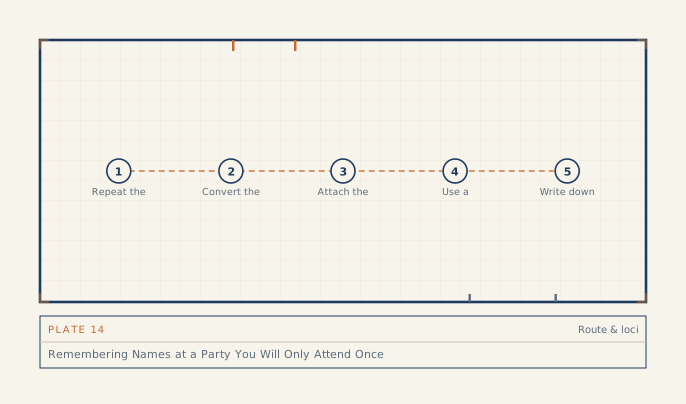
Repeat the name out loud within two seconds, in a sentence, not as an echo.
Looks like"\"Priya — is that the Sanskrit one, meaning beloved?\" buys you two seconds and confirms the sound."
-
2
Convert the name into a concrete object or action at the moment you hear it.
Looks likeBaker becomes a baker's rolling pin; Hu becomes a tiger (虎); Lim becomes a lime.
-
3
Attach the object to the most distinctive physical feature and make the contact absurd.
Looks likeIf Priya has a red scarf, the rolling pin is baking bread inside her scarf and steam is coming out of it.
-
4
Use a second pass at the end of the conversation to re-fire the image.
Looks like"\"Good to meet you, Priya\" plus one internal re-look at the scarf is what moves the name past the two-minute cliff."
-
5
Write down the three names you want to keep within ten minutes of leaving.
Looks likeAny name you can write from memory after leaving is stored; the rest were never converted. The written count is your honest score.
03Worked example
| Image in the head | Anchor point |
|---|---|
| Miller — a windmill that will not stop turning, wedged in the person's beard. | Feature used: beard. Risk: low, because the feature is unusual. |
| Chen — the person's glasses are made of two thin layers of dust (尘). | Feature used: glasses. Risk: medium — two other people also wore glasses. |
| Tan — a beach tan line running up the person's forearm. | Feature used: forearm. Risk: medium — needs a distinguishing detail on the same arm. |
| Wu — five (五) small umbrellas growing out of the person's hairline. | Feature used: hairline. Risk: low, and the number five doubles as a check digit. |
04Where it breaks
- Waiting until the end of the conversation to convert. By then the sound is already gone and you are converting a guess.
- Building a name image with no feature attached. An image floating in space has no address, so you will recall the image and not who it belonged to.
- Using the same feature for everyone in the room. Three people with rolled-up sleeves will merge into one person by the end of the evening.
- Converting only the first name. Surnames carry the social weight at work, and they need their own image or they will not survive.
05Practice drill
00:00
10 min
Open a news site and take ten photographs of people you do not know, each with a name in the caption. Run the three-second pipeline on each one, in order, without pausing. When you reach the tenth, look away and write down names one to ten. Score yourself, then repeat with ten new faces — the improvement across rounds comes almost entirely from shortening your conversion time.
Run the drill with the clock on. Stop when the instructions say to.
06Questions
What if the name is unusual and I do not know its meaning?
Convert the sound, not the meaning. A nonsense but vivid object built from the syllables beats a correct etymology you have to look up, because the pipeline has three seconds and looking things up takes longer.
Do I need a memory palace for names?
Not for a single evening. A palace helps when you are meeting the same fifty people repeatedly over months, because then the palace holds the ongoing record rather than the individual name.
Should I tell people I use a technique?
Occasionally it helps — asking "how do you spell that?" is a legitimate conversion step and most people are pleased to be asked. Announcing the system, however, usually shifts the conversation onto the technique and away from the person.