A PAO System for a Deck of Cards
Fifty-two cards, thirteen images, three slots each — and the arithmetic that makes it fast.
01Why it works
A person-action-object system assigns every card a person, an action and an object, then encodes three cards as one image by combining the first card's person, the second card's action and the third card's object. Fifty-two cards become eighteen images instead of fifty-two. The economy is not in the images themselves but in the combinatorics: 13 persons x 13 actions x 13 objects gives 2197 distinct combinations, so the same small cast produces almost no collisions across a whole deck.
02The five moves
-
1
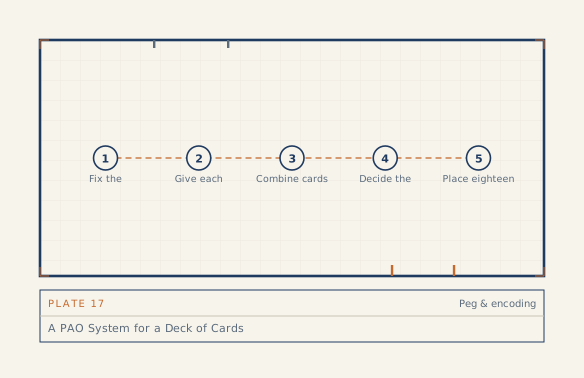
Fix the thirteen ranks to thirteen people before touching suits. Ranks give you the cast; suits modify nothing at this stage.
Looks likeAce is a specific person you know, two is another, through to king. Using real acquaintances beats fictional characters because their actions are already vivid to you.
-
2
Give each person exactly one action and one object, and write all thirty-nine down.
Looks likeIf person 7 is your uncle, his action might be "arguing about the thermostat" and his object "a folded newspaper". Both must be specific enough to draw.
-
3
Combine cards three at a time in the fixed slot order — person, action, object.
Looks like7 of hearts, 3 of spades, king of clubs becomes: uncle (7) performs the action of person 3, holding the object of person K.
-
4
Decide the suit rule once and apply it everywhere. Most competitors ignore suits entirely and rely on the probability that exact duplicates are rare.
Looks likeIf you do encode suits, the usual choice is to tint the whole image — hearts red, spades black, and so on — which costs almost no extra time.
-
5
Place eighteen images on a palace with at least eighteen stops, and rehearse at speed with a timer.
Looks likeA beginner takes six to eight minutes for a deck; the target for competition is under sixty seconds, and the gap closes through timed repetitions rather than better images.
03Worked example
| Image in the head | Anchor point |
|---|---|
| Card 1 — 4 of diamonds. Person slot: person 4, "the neighbour with the dog". | supplies the PERSON |
| Card 2 — 9 of spades. Action slot: person 9's action, "reversing a car badly". | supplies the ACTION |
| Card 3 — jack of hearts. Object slot: person J's object, "a watering can". | supplies the OBJECT |
| Combined image — the neighbour is reversing her car while watering the flowerbeds out of the window. | one palace stop holds three cards |
| Deck arithmetic — 52 cards / 3 = 17 triples plus one leftover card, so 18 images. | why PAO cuts a deck into roughly a quarter of the work |
04Where it breaks
- Choosing famous people whose actions overlap. Two footballers both kick things, and the action slot then identifies neither card.
- Building the list and never timing it. Without a timer you will plateau at a comfortable speed and assume you have hit your limit.
- Using objects that cannot be held. "A conversation" cannot be picked up by a person from another slot, so the third card has nowhere to go.
- Attempting PAO before the Major system or a solid palace habit. PAO is a multiplier, and multiplying a slow base makes a slower system.
05Practice drill
00:00
20 min
Build only the thirteen persons today, with an action and an object each, and write all thirty-nine entries down. Shuffle a deck and deal ten triples; do not try to memorise them, just decode each triple out loud into a sentence as fast as you can, and time it. Decoding speed is the bottleneck for the first month, not encoding speed.
Run the drill with the clock on. Stop when the instructions say to.
06Questions
Do I need PAO to memorise a deck at all?
No. You can hold 52 cards as 52 individual palace stops and finish a deck in two to three minutes. PAO is a speed system; it pays off only if you are training for time.
Can the same person appear twice in a deck?
Yes, up to four times, because each rank appears once per suit. That is exactly why the combination matters — the triple is unique even when the person is not.
How long does building the system take?
About two weeks of twenty-minute sessions to build and roughly three months of timed practice to reach one minute per deck. Anyone quoting a weekend is quoting the build time only, not the fluency.