Mind Maps Are Not Memory Palaces
Both put things in space. Only one of them puts them in an order you can walk.
01Why it works
A mind map encodes relationships — this belongs under that, these two connect. It is excellent for seeing structure and terrible for ordered recall, because the branches have no fixed sequence. A palace encodes addresses. Choosing between them is not a matter of taste: ask whether you need the structure or the order. Exam essays often need both, which is why the practical answer is a map drawn first, then a palace built along the map's branches.
02The five moves
-
1
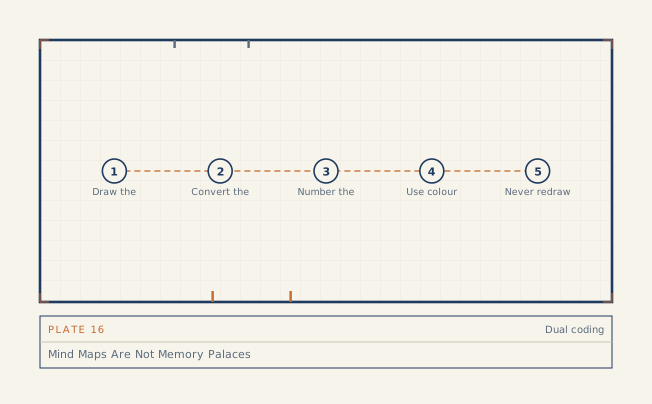
Draw the map first when the material is new, to find out what the parts are.
Looks likeA map of a physiology topic reveals that you have six sub-systems and have understood only four of them.
-
2
Convert the map to a palace once the structure is settled, using one room per first-level branch.
Looks likeSix sub-systems become six rooms, each holding four or five stops. The map's hierarchy becomes the palace's floor plan.
-
3
Number the branches on the map. A map without numbers cannot be walked in a fixed order.
Looks likeClockwise from the top-right is the standard convention, and it is worth following because everyone else's maps will read the same way.
-
4
Use colour on the map for categories, not for decoration.
Looks likeThree colours meaning "known", "shaky" and "unknown" turns the map into a study plan the moment you finish drawing it.
-
5
Never redraw a map you have already made. Redrawing produces a beautiful artefact and no new retrieval.
Looks likeInstead, cover the map and reproduce the top level from memory, then check. That is retrieval; redrawing is transcription.
03Worked example
| Image in the head | Anchor point |
|---|---|
| Linear notes — everything present, nothing prioritised. | Good for: searching later. Bad for: recall. |
| Mind map — structure visible at a glance, no sequence. | Good for: planning an answer, spotting gaps. Bad for: ordered recall. |
| Palace built along the map's numbered branches. | Good for: reproducing the whole structure in order under pressure. Costs about an hour to build. |
04Where it breaks
- Treating a map as a revision tool. A map you can look at is not a map you can reproduce; the two skills are unrelated.
- Building elaborate maps with images on every branch. The decoration competes for attention with the structure, which was the point of drawing it.
- Skipping the map and going straight to a palace for unfamiliar material. You will build a palace of things you have not yet understood, which stores the confusion faithfully.
- Mapping and palacing everything. Both cost time; most material only needs one pass of ordinary study.
05Practice drill
00:00
14 min
Take a topic you can already explain. Draw a numbered mind map in ten minutes. Then close the map and reproduce only the first-level branches and their numbers from memory — nothing else. Then build a six-stop palace where each stop is one branch. Recite the branches by walking the route and compare that against reciting them from the map's numbers.
Run the drill with the clock on. Stop when the instructions say to.
06Questions
Can software mind maps replace hand-drawn ones?
For planning, yes. For encoding, no — the same reason as with diagrams. Hand drawing forces you to decide where a branch goes and then accept that decision, which is the part that encodes.
Which one should I teach a child?
The map, and only the map, until about age eleven. Palace techniques need a stable spatial vocabulary that younger children often do not have yet, and a poorly built palace teaches a child that the method does not work.
Why do maps feel more productive than palaces?
Because a map leaves visible evidence of work and a palace leaves none. That is a feeling, not a measurement. Test both by covering your notes a week later and reproducing the material — the comparison is usually uncomfortable.