Keyword Mnemonics for Vocabulary, and Their Expiry Date
They get you to four hundred words fast and then they start costing you.
01Why it works
A keyword mnemonic links the sound of the foreign word to a word you already know, then links that to the meaning. For a language whose vocabulary barely overlaps with yours, this is a large early win — it gives you a retrievable hook for a word you have no context for. The cost arrives later, because every recall has to pass through the keyword image. Once a word is familiar, the mnemonic becomes a detour, and learners who keep using it plateau while learners who drop it keep improving.
02The five moves
-
1
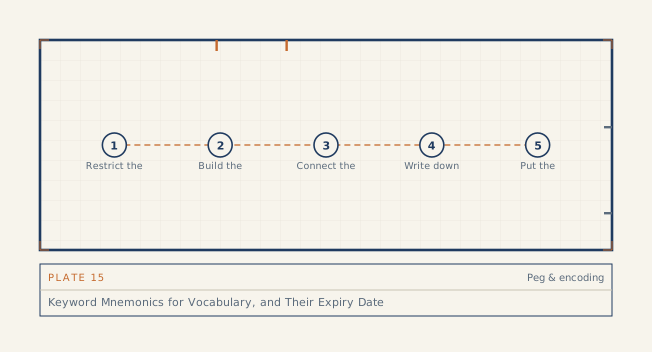
Restrict the technique to words with no cognate and no transparent structure.
Looks likeFor an English speaker learning Japanese, "ringo" (apple) is a candidate; "hoteru" (hotel) is not, because it is already recognisable.
-
2
Build the keyword from the sound, allowing it to be approximate.
Looks likeJapanese "ringo" splits usefully into "ring" plus "go" — a ringing apple that keeps going.
-
3
Connect the keyword image to the meaning in one scene, with the meaning as the actor.
Looks likeNot "a ring and an apple side by side" but "the ring is biting the apple".
-
4
Write down the date when you will retire the mnemonic, and actually retire it.
Looks likeAfter five spaced reviews, cover the keyword and answer from the word alone. If you can, delete the mnemonic from your notes so it cannot become a permanent crutch.
-
5
Put the word into a sentence from your own life immediately after retiring the mnemonic.
Looks like"\"I rang the apple\" is a bad sentence; \"the apple is ringing at 7 a.m. because my alarm sounds like a bite\" is one you will remember, which is what replaces the crutch."
03Worked example
| Image in the head | Anchor point |
|---|---|
| meticulous — sounds like「马蹄」: a horse's hooves are so careful that it steps around every crack. | Retire when: you use it once in a real sentence. |
| stubborn —「死大本」: a huge ledger that refuses to be closed no matter how hard you push. | Retire when: two spaced reviews pass without the image. |
| mortgage —「摸给」: you have to hand over the house with a touch (mort = death in French, gage = pledge). | Retire immediately: this word has a transparent Latin root and should be learned as one. |
| vacillate —「哇塞累」: too tired to decide anything. | "Retire when: you can state the difference between it and \"hesitate\"." |
04Where it breaks
- Building a mnemonic for a word you have already met five times. If it is already familiar, the mnemonic delays recall instead of helping it.
- Using the technique for a whole language. Five hundred keyword images compete with each other and the sound associations blur.
- Never retiring anything. A learner who still needs a mnemonic for a word they use weekly has built a permanent intermedicry.
- Confusing the keyword with the meaning. If you only recall "ringing apple", you have learned the mnemonic, not the word.
05Practice drill
00:00
12 min
Take fifteen words you have failed to retain through ordinary reading. Build keyword mnemonics for ten of them and learn the remaining five by plain repetition in sentences. Next week, test all fifteen. Compare the two groups — most learners find the mnemonics win early and the sentence group closes the gap by the second or third test.
Run the drill with the clock on. Stop when the instructions say to.
06Questions
Do keyword mnemonics work for tones and characters?
They work differently for each. Tones are better learned as part of a spoken chunk than as images. Characters are better learned through component stories, which is a related but separate technique with a much longer useful life, because the components are real.
How many words should carry a mnemonic at once?
Around fifty. Past that the keyword images start colliding with each other and you spend more time sorting them out than you saved.
Is it cheating to use the first language?
No, but it is a bridge rather than a destination. The test is whether the word eventually becomes available without passing through the bridge. If it never does, the mnemonic has become part of the word, which is a problem, not a solution.