The Greenhouse
When the list is long and the items are similar, use a room where everything is similar too.
01Why it works
Long rosters fail because the items have nothing to distinguish them apart from their labels. A greenhouse looks like a bad choice for the same reason — row after row of the same shape — but the rows are actually an advantage. Position in a row becomes the distinguishing feature, so the encoding is carried by ordinal position rather than by image quality. That suits taxonomies, where what you need is membership and rank, not a memorable story about each item.
02Floor plan
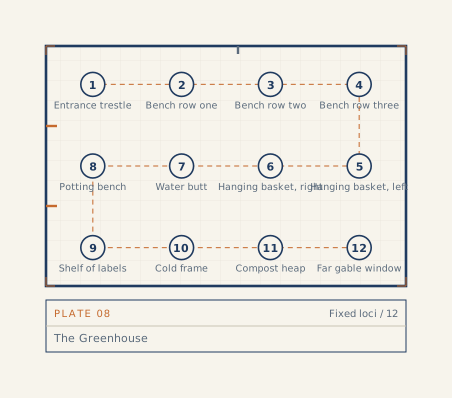
Long glasshouse. Door centred on the west gable, glazed roof span on the north side.
03Locus
| Locus | Anchor | Holds |
|---|---|---|
| 1. Entrance trestle | The first flat surface inside, used for tools and nothing else | The name of the whole group — the heading everything else hangs from. |
| 2. Bench row one | Nearest the door, easiest to reach, most disturbed | The most common members of the group, the ones you will use daily. |
| 3. Bench row two | One step in, slightly shaded by row one | The next tier — sub-groups and their distinguishing features. |
| 4. Bench row three | Middle of the house, the widest bench, holds the most | The bulk of the roster, held in order rather than individually. |
| 5. Hanging basket, left | Above head height, seen before anything else, impossible to touch | Edge cases that belong to the group but sit outside the main sequence. |
| 6. Hanging basket, right | Mirror position of the left, same height, different contents | The exclusion you must not forget — what is not in this group. |
| 7. Water butt | Large, open, everything that goes in comes out the same | The standard example you compare all other members against. |
| 8. Potting bench | Dirty, actively used, things get separated here | The point where two sub-groups divide. |
| 9. Shelf of labels | Small identical objects distinguished only by what is written on them | Naming conventions and the rules that generate the names. |
| 10. Cold frame | Low, covered, holds things that have not yet grown into their label | Provisional members — things you have classified but not yet confirmed. |
| 11. Compost heap | At the far end, out of the walking line, everything eventually goes here | Superseded classifications — the old scheme you must stop using. |
| 12. Far gable window | The end of the axis, the point the whole building aims at | The exception that proves the rule, and the test case examiners like. |
04The walk
-
1
Enter and put the group name on the trestle b…
Enter and put the group name on the trestle before anything else. A roster without its heading is a list of strangers.
-
2
Walk the benches in order, putting the most c…
Walk the benches in order, putting the most common members nearest the door and the rarest furthest in.
-
3
Look up at the two hanging baskets from the m…
Look up at the two hanging baskets from the middle of the house. Edge cases and exclusions are both overhead, and you should be able to see them without walking.
-
4
Turn at the water butt and use it as the comp…
Turn at the water butt and use it as the comparison standard — every uncertain member gets held next to it.
-
5
Exit past the potting bench, the label shelf,…
Exit past the potting bench, the label shelf, the cold frame, the compost heap and the far window. The compost heap is last on purpose: old schemes should be the furthest thing from the door.
05Where it breaks
- Giving every member its own vivid image. A roster of forty with forty memorable images is forty things to forget; the point of this room is that position carries the load.
- Skipping the exclusion locus. Knowing what is not in a group is half of taxonomy and has no other natural home.
- Walking the benches out of order. Ordinal position is the encoding here, so an inconsistent walk destroys the only structure you have.
- Leaving obsolete classifications on the main benches. Superseded schemes must sit at the far end, or they will be recalled alongside the current one.
06Practice drill
00:00
11 min
Take a list of twenty similar items — species, currencies, statutes, component numbers. Assign the first six to benches one to three in order, then place the rest in groups of four along the same benches without individual images. Cover the list and reproduce it in order. Then reproduce it backwards. Position-based storage shows its weakness immediately when reversed, and that weakness is your signal to add an image to the specific pairs that failed.
Run the drill with the clock on. Stop when the instructions say to.
07Questions
How is this different from putting the list in a bookshelf?
A shelf encourages hierarchy and a greenhouse encourages sequence. Use the study when the structure is a tree and the greenhouse when it is a long ordered row with few internal distinctions.
Do I need the glass and the plants?
No — what you need is a long room with a single clear axis and repeated identical stations. A car park, a station platform or a laundry aisle will do the same job if you know it well.
At what list length should I switch away from images?
When more than about a third of the items are ones you would not recognise out of context. Below that, individual images are still worth the time; above it, position is doing the work anyway and extra images just compete.