The Music Room
The only room where the loci themselves make noise.
01Why it works
The room is used twice — once for the shape of the sound, once for its meaning.
02Floor plan
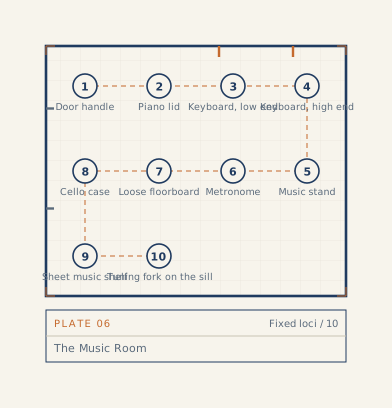
Door on the north wall, facing the piano; single tall window on the west wall.
03Locus
| Locus | Anchor | Holds |
|---|---|---|
| 1. Door handle | Metal, clicks once, heard before the room is seen | The initial sound of a word — the part that most often gets dropped. |
| 2. Piano lid | Heavy, resonant when closed, hollow when open | Vowel length — the distinction that changes meaning without changing spelling. |
| 3. Keyboard, low end | Long strings, slow decay, felt in the chest | Low or falling tones. |
| 4. Keyboard, high end | Short strings, fast decay, felt in the teeth | High or rising tones. |
| 5. Music stand | Flat, angled toward you, holds exactly one page | The written form, kept deliberately separate from the sound. |
| 6. Metronome | Repeats, regular, impossible to ignore once started | Stress and rhythm — which syllable carries the weight. |
| 7. Loose floorboard | Creaks at one specific spot, never anywhere else | Exceptions — the words that break the pronunciation rule you just learned. |
| 8. Cello case | Closed, curved, something large inside taking up space | Minimal pairs held as a single contrasting unit. |
| 9. Sheet music shelf | Loose pages, ordered by nothing visible | Sets of sounds you must tell apart quickly in speech. |
| 10. Tuning fork on the sill | One pure fixed pitch, always the same | The reference sound — the one you compare everything else against. |
04The walk
-
1
Start at the door handle before entering. Fee…
Start at the door handle before entering. Feel the click; that click is the initial sound you are storing.
-
2
Open the lid and hold the vowel there. Do not…
Open the lid and hold the vowel there. Do not move on until you can hear the length of it.
-
3
Play the low end, then the high end, and put …
Play the low end, then the high end, and put the falling tone on one and the rising tone on the other. Keep the direction consistent across every session.
-
4
Read the written form off the music stand, th…
Read the written form off the music stand, then beat the stress on the metronome. Two loci, two different jobs.
-
5
Step on the loose board last, deliberately. E…
Step on the loose board last, deliberately. Exceptions should be the loudest thing in the room, because they are the ones you will otherwise learn wrong.
05Where it breaks
- Using the piano as one locus. The keyboard is a spectrum, not a point; if you do not fix low and high to specific keys, tones will float.
- Putting meaning and sound on the same locus. The music room works because it splits them; merging them gives you a picture you cannot pronounce.
- Practising silently. This is the one palace where reading it in your head defeats the purpose entirely.
- Changing the tone direction between sessions. Low-as-falling only works if low is always falling; swap it once and both tones become ambiguous.
06Practice drill
00:00
10 min
Take six words in a tonal language and place them on six loci, using only the sound-carrying positions — handle, lid, low end, high end, metronome, loose board. Say each word aloud as you touch the locus. Cover the list and walk the room twice, once forwards and once backwards. Backwards is the harder direction and the one that shows whether the tone is stored or guessed.
Run the drill with the clock on. Stop when the instructions say to.
07Questions
I do not have a music room. Can I use headphones instead?
Partly. You can build a sound-carrying palace out of a playlist, where each track is a locus, but the loci then have no physical location and you lose the spatial component that makes them walkable. Better to find one real room with distinctive noises — a kitchen has several.
Does this work for non-tonal languages?
Yes, with the roles reassigned. Instead of tones, use it for vowel length, stress position and any consonant contrast your first language does not have — which for most learners is where the actual difficulty lies anyway.
How many sessions before the sound sticks?
Three or four short sessions beat one long one, and the sound needs to be produced aloud each time. Receptive practice — just listening — does not build the retrieval path you need when speaking.