The Study
A room full of flat horizontal surfaces, which is exactly what arguments need.
01Why it works
Conceptual material has no natural shape. A study supplies one: shelves impose hierarchy, a desk imposes a working surface, a chair imposes a point of view. Mapping an argument onto that furniture turns an abstract structure into a walkable one. The desk matters most, because it is the only locus where you can put two things side by side, and comparison is what most conceptual recall is actually asking for.
02Floor plan
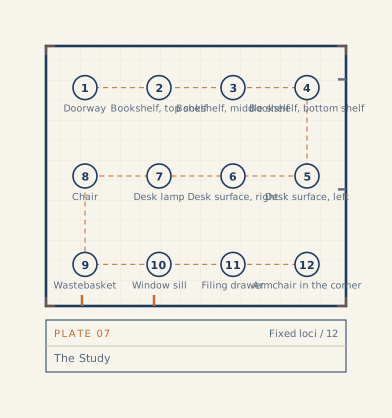
Door on the south wall at the western end; one wide window on the east wall.
03Locus
| Locus | Anchor | Holds |
|---|---|---|
| 1. Doorway | The boundary between the corridor's noise and the room's quiet | The thesis itself — the one sentence the whole argument exists to support. |
| 2. Bookshelf, top shelf | Highest, least reachable, holds the things you consult rarely | The frame — definitions and assumptions you will not re-examine. |
| 3. Bookshelf, middle shelf | Eye level, spine-out, the working reference section | The main supporting claims, in order. |
| 4. Bookshelf, bottom shelf | Crouch height, dusty, easy to neglect | The weakest claim in the argument — the one you should be able to defend first. |
| 5. Desk surface, left | Flat, clear, the side where you spread things out | The first side of a comparison. |
| 6. Desk surface, right | Same surface, opposite side — distance in space reads as difference in kind | The second side of the comparison, deliberately placed as far from the first as possible. |
| 7. Desk lamp | Directional, creates a bright spot and a shadow | The evidence, and specifically what it does not cover. |
| 8. Chair | Only one seat, only one occupant | The opposing view — the position you must be able to state fairly. |
| 9. Wastebasket | Around the corner of the desk, easy to aim at and miss | Arguments you have considered and rejected, with the reason they failed. |
| 10. Window sill | Bright, hard, everything on it is backlit | The conclusion, and what would follow if it were wrong. |
| 11. Filing drawer | Pulls out, hides most of its contents until opened | Methods you used, which you will need if the conclusion is challenged. |
| 12. Armchair in the corner | Low, separate from the desk, where you sit when you stop working | What remains open — the questions the material did not answer. |
04The walk
-
1
Enter and stop in the doorway. The thesis goe…
Enter and stop in the doorway. The thesis goes here before anything else, so that every later stop is measured against it.
-
2
Sweep the bookshelf from top to bottom, putti…
Sweep the bookshelf from top to bottom, putting assumptions above supporting claims and the weakest claim lowest.
-
3
Sit at the desk and work left to right: compa…
Sit at the desk and work left to right: comparison side one, comparison side two, then the lamp. The lamp is the step people skip, and it is the one that carries the evidence.
-
4
Turn the chair around and state the opposing …
Turn the chair around and state the opposing view aloud from it. Speaking from the opposing seat is what stops you strawmanning it.
-
5
Close at the wastebasket, window sill, drawer…
Close at the wastebasket, window sill, drawer and armchair — rejected arguments, the conclusion, the methods, and what is still open. Leave the room; the armchair is the last thing you touch.
05Where it breaks
- Treating the desk as one locus. Left and right are only separate if you physically move between them; otherwise the comparison collapses into a single blurry image.
- Stacking every claim on the middle shelf. The three shelf levels exist to encode weak-to-strong, and using only one level throws away the hierarchy the room provides.
- Skipping the wastebasket. Rejected arguments are the part examiners ask about, and they have no natural home unless you give them one.
- Using the chair for yourself. If you sit in it to think, it stops encoding the opposing view and becomes an ordinary seat.
06Practice drill
00:00
11 min
Take one argument you can already summarise in a paragraph. Map it onto the twelve loci, then do the two tests that matter: first, recite the whole argument from the route without notes; second, sit in the chair and give the opposing case for ninety seconds without using any phrase that begins with "they say". If you cannot do the second, the argument is stored as a position rather than as a structure.
Run the drill with the clock on. Stop when the instructions say to.
07Questions
Is twelve loci too many for one room?
For a study it is fine, because the shelves alone supply three easily distinguished heights. The general rule still applies: if you cannot name all twelve out loud in order on the first try, cut to eight.
Should I use my own study or an imagined one?
Your own, always. The whole advantage is that you already know where things are without looking, and an imagined study is a study you have to learn first.
How does this handle material that is mostly diagrams?
Give the diagram its own locus — the window sill works, because it is flat and bright. Then the route carries the sequence of diagrams rather than the contents of each one.