The Kitchen
Wet surfaces hold images better than clean ones, which is why vocabulary sticks here.
01Why it works
Kitchens are unusually rich in textures that change state: something is always boiling, cooling, dripping or being cut. A locus whose surface changes gives every image a built-in verb, and verbs are what make an image retrievable. The room also offers a natural order — the order in which you actually cook — which means the route does not have to be invented, only observed.
02Floor plan
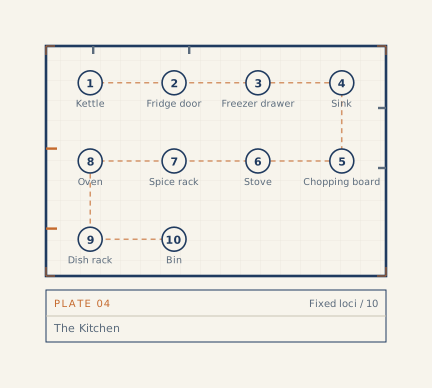
Galley layout. Door on the west wall, two windows on the north and east.
03Locus
| Locus | Anchor | Holds |
|---|---|---|
| 1. Kettle | Loud, hot, the first thing that acts on its own | Words that must be pronounced before they can mean anything. |
| 2. Fridge door | Opens outward, everything behind is cold and half-hidden | Lists of things with dates attached — use-by information, deadlines. |
| 3. Freezer drawer | Metal, frosted over, needs force to open | Items you want frozen in place — fixed values, constants. |
| 4. Sink | Drains, holds nothing, always slightly wet | Things to be discarded — distractors, false friends, common errors. |
| 5. Chopping board | Cut flat, layered, always mid-task | Words that break into parts — prefixes, radicals, syllables. |
| 6. Stove | High heat, transforms whatever sits on it | Irregular forms — the ones that do not follow the rule. |
| 7. Spice rack | Many small identical containers, distinguishable only by label | Sets that differ by one small feature — minimal pairs, tones, near-synonyms. |
| 8. Oven | Closed, timed, produces something at a known moment | Anything with a scheduled outcome — your own review dates. |
| 9. Dish rack | Slotted, everything vertically stacked and drying | Ordered sequences you read top to bottom. |
| 10. Bin | Foot-operated, lid closes itself | The item you want to make sure you never recall in the wrong context. |
04The walk
-
1
Enter from the west door and put the kettle o…
Enter from the west door and put the kettle on first — item one, before you have looked anywhere else.
-
2
Open the fridge, then pull the freezer drawer…
Open the fridge, then pull the freezer drawer. Items two and three, both cold.
-
3
Move to the sink and let items you want gone …
Move to the sink and let items you want gone fall into it. Item four is deliberately disposable.
-
4
Board, stove, spice rack in one sweep along t…
Board, stove, spice rack in one sweep along the counter. Items five, six and seven.
-
5
Close with oven, dish rack, bin. Items eight …
Close with oven, dish rack, bin. Items eight to ten, then wash your hands — the physical exit is what ends the rehearsal.
05Where it breaks
- Placing items on the countertop between loci. A counter is one continuous object; items placed in the gaps belong to no locus and merge into the next one.
- Using the fridge twice. Fridge door and freezer drawer are different loci only if you actually touch both; if you open the fridge and glance down, the two merge.
- Putting a pleasant image in the bin. The bin is for material you want to be able to discard; filling it with something valuable guarantees you will half-remember it.
- Cooking in the middle of a rehearsal. The route depends on surfaces being in expected states; if the board is in the sink the ordering breaks.
06Practice drill
00:00
10 min
Write eight foreign words you keep forgetting. Place each on the kitchen loci one to eight with a verb, not a noun — something must be boiling, cutting or closing. Recite the route once, then walk the actual kitchen and name each word as you touch the corresponding object. Touching is the point: the drill is testing whether the real kitchen cues the words, not whether you can picture the kitchen.
Run the drill with the clock on. Stop when the instructions say to.
07Questions
What if I do not cook and the kitchen is unused?
Then use it anyway, but you lose the natural cue order and will have to write the route down and rehearse it more. An unused kitchen is a stable room, which is a genuine advantage — nothing moves.
How is this different from any other room?
State change. Most rooms hold static furniture, so images have to supply their own motion. A kitchen supplies motion for free, which shortens the time it takes to build a good image.
Is ten loci the maximum for a kitchen?
The ten above are the ones most people can distinguish reliably. If your kitchen is large you can add a pantry and a washing machine, but audit them first — both are often visually identical to their neighbours in other people's kitchens.