The Threshold
The room you pass through in four seconds is the best place to lose forty numbers.
01Why it works
A threshold is entered and left in one motion, which makes it ideal for material you need to pull out instantly rather than browse. Every locus sits at hand height within arm's reach of the door, so the whole room can be scanned without turning around. Because nothing in a threshold is comfortable, items placed there stay slightly annoying, and slightly annoying images survive longer than pleasant ones.
02Floor plan
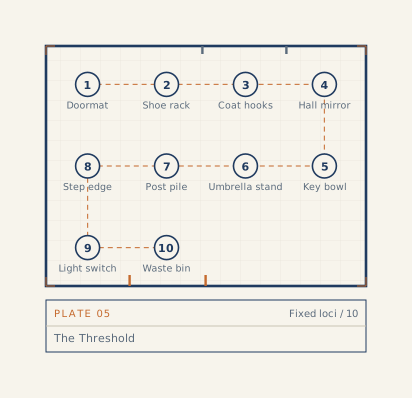
Orthographic plan, one-metre grid. Door notch to the south, single window to the north.
03Locus
| Locus | Anchor | Holds |
|---|---|---|
| 1. Doormat | Flat, directly inside the door, always the first thing underfoot | The single item you must not forget at the start — a year, a first digit, a title. |
| 2. Shoe rack | Two tiers, uneven load, something always falling off | Items that come in pairs or matched sets. |
| 3. Coat hooks | Four hooks at eye level, empty half the year | Anything you want to hang, wear or drape — names, labels, titles. |
| 4. Hall mirror | Vertical, face-height, shows whatever is behind you | Reversals and opposites — dates that run backwards, negative numbers. |
| 5. Key bowl | Shallow, resonant, everything dropped in it makes a noise | Small high-value items: PINs, currency codes, short codes. |
| 6. Umbrella stand | Tall and narrow, reachable without bending | Long thin things — phone numbers read as a single run. |
| 7. Post pile | Loose, layered, edges visible from the side | Ordered lists where position matters more than content. |
| 8. Step edge | Raised, one stride, forces a change of level | Thresholds in the material — the point where one topic becomes another. |
| 9. Light switch | Hand height, operated without looking | On/off facts — binary distinctions, true/false pairs. |
| 10. Waste bin | Low, out of sight, the last place you check | The final item in a sequence, and anything you expect to be tempted to drop. |
04The walk
-
1
Stand at the door and look at the doormat. Pl…
Stand at the door and look at the doormat. Place item one; do not move yet.
-
2
Step in and turn left, sweeping the shoe rack…
Step in and turn left, sweeping the shoe rack and the coat hooks in one movement. Items two and three go there.
-
3
Face the mirror, then the key bowl directly b…
Face the mirror, then the key bowl directly beneath it. Items four and five.
-
4
Walk the last three metres in a single line: …
Walk the last three metres in a single line: umbrella stand, post pile, step edge, light switch, bin.
-
5
Turn around and walk back out, naming each lo…
Turn around and walk back out, naming each locus as you pass it. If any stop is silent, the route has fewer than ten usable positions and should be cut to eight.
05Where it breaks
- Placing an item on the door handle. The handle is touched twice, at both ends of the walk, so the item will appear both first and last.
- Using the mirror as a locus for something you need to read forwards. Mirrored text is the fastest way to store a reversed number by accident.
- Adding an eleventh stop in the doorway between two rooms. The doorway does not belong to either room and gets skipped when you walk through quickly.
- Leaving the plan in your head instead of on paper. A threshold has fewer distinguishable surfaces than you think; the written plan is what catches the duplicate.
06Practice drill
00:00
9 min
Take six two-digit numbers and place them on loci one to six. Walk the route out loud, then write the numbers down in the order you saw them. Now do the same six numbers on loci five to ten and compare your accuracy. Most people find the second half of a threshold is weaker, which tells you to reorder the loci so the hardest material sits near the door.
Run the drill with the clock on. Stop when the instructions say to.
07Questions
My threshold is tiny. Is ten loci realistic?
Usually not — a small threshold genuinely offers six to eight distinguishable positions. Run the room at eight and start a second palace rather than inventing two stops out of the skirting board.
Does it matter which direction I walk?
It matters that you always walk the same way. Direction itself is arbitrary, but alternating between entering and leaving will put the same item at both ends of the list.
Can two people share one threshold plan?
They can share the shape of the route but not the anchors. Your doormat is a flat thing you step on; someone else's may be the only place the cat sleeps, which changes what an image can do there.